Wakfu is a new turn-based tactical MMORPG by Ankama Games, and published by Square Enix in North America. Set 1000 years after the Dofus games and a major cataclysm, Wakfu features the same classes and anime-styled graphics and touts itself as having an entirely player-run world. Resources, politics, economy, and infrastructure can all be influenced, for better or for worse, by players.
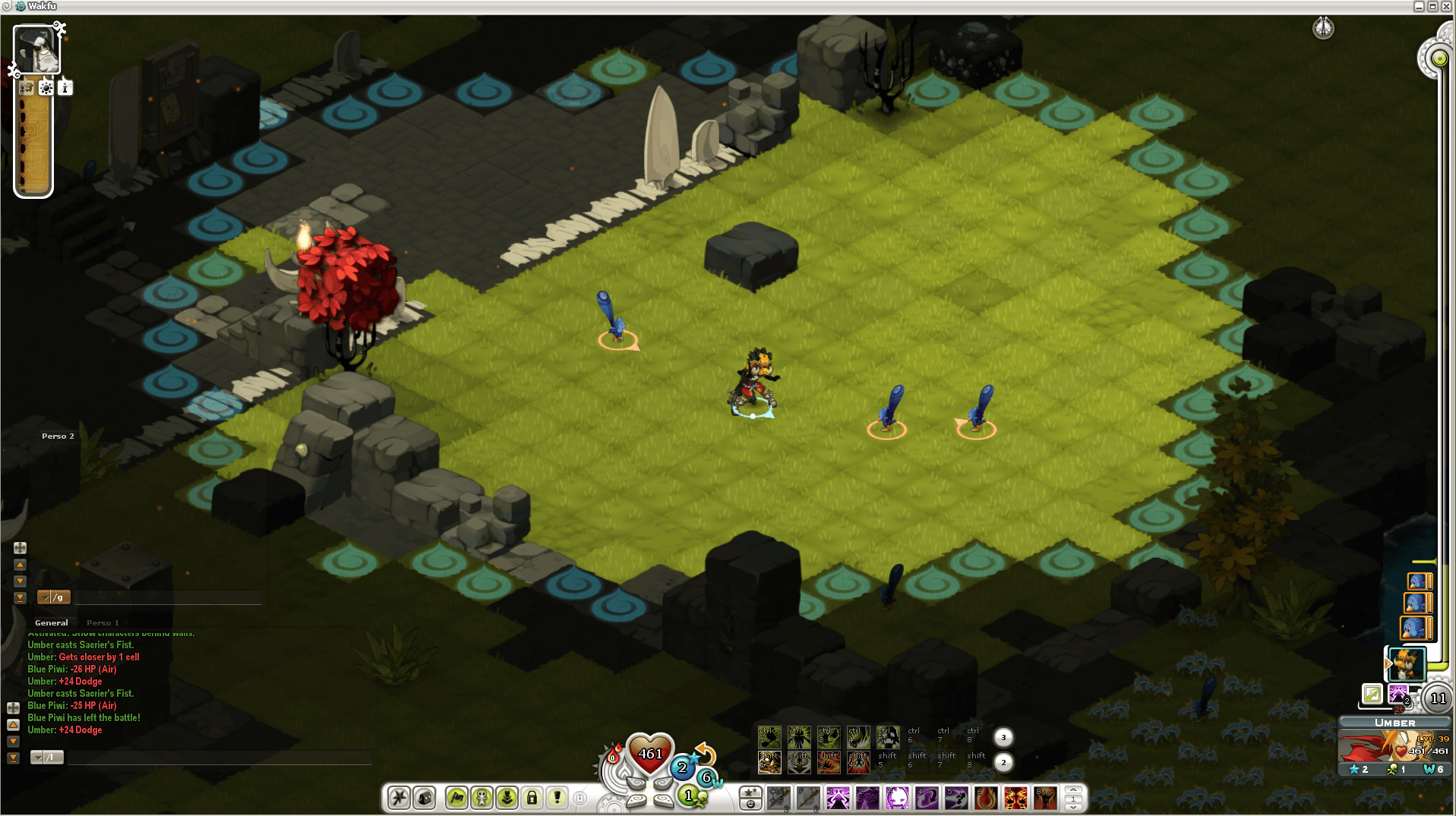
Now it’s on, tiny birds.
Before I start talking about the game, know this: Wakfu has just been released, and the player base is kind of low at the moment. It is also still being updated, and the mechanics are being modified and balanced on a regular basis. As a result, as players sign up, (or leave, I suppose,) and the game is patched, experiences may vary.
One of the first things I noticed about Wakfu was the deadly and vicious nature of the enemies you face. Just a few of the monstrous foes I have vanquished include happy kittens, small birds, affectionate sheep, and dandelions. (To be fair, the dandelion was pretty angry.) There’s a kind of bird, called a Tofu, which hides, trembling in terror, as you come to kill it. I’ll admit, even as jaded as I am, I felt kind of bad punching them to death with flaming fists. These aren’t the only enemies, but many others follow in a similar vein. In all, Wakfu is a very happy place, making it a more kid-friendly MMO than many, and it comes with a robust language filter. The most adult thing in the game was the (rather concerning) humping animation by the gobballs (Wakfu sheep). I think the only reason it surprised me at all was its contrast with the innocent nature of the rest of the game.
One of the strangest things about the game for me was economy. The only way currency enters the system is when players actually craft it out of mined metals. There are no NPC vendors to sell loot to either, only other players. Common and low level equipment drops are often worthless, because the market is flooded with them already, and no one wants them. In contrast with other MMORPGs, where you can sell pretty much anything you find, being forced to throw away loot is definitely unusual. (And, for a loot fiend like myself, frustrating and painful.) It will be interesting to see what happens to the economy as more players and more currency enters the system. So far as I can tell, there are only a few money sinks in the game too, namely transportation, sales taxes and infrastructure construction. Unless new construction options are introduced, all of the available construction projects will soon be completed as well, leaving only the first two.
Wakfu has a traditional market system, where players can post their items and select a duration for the sale. Longer durations and higher prices mean higher taxes, which are not returned if the item does not sell. Each nation in the game has it’s own separate market, and players can post on each one a maximum of 10 items on each one. In addition to this, each player also has a Haven Bag market. Haven Bags are magic sacks players can climb into, leading to a small customizable area within the bag. Each player starts with a basic shelf, which acts as a 3-slot market with no duration limit on sales. The drawback to this is that the items for sale can only be seen and purchased by other players when they are interacting with the Haven Bag. This means that there is no way to search, and you will often end up wading through large volumes of crap that is not your level, not applicable to your class, not useful for any of your crafting professions, or just wildly overpriced. Needless to say, this quickly becomes tedious, and I found myself largely ignoring Haven Bag shops in favour of the market. That said, there were a few interesting moments when Haven Bag shops would be selling items relevant to a specific location, like keys to get into a dungeon, just outside of them, for higher than market price. With a few tweaks this system could really shine, but in its current state it’s somewhat hobbled.
With no NPC vendors, it is up to the players to create and sell all items in the game. As one might expect, especially with a small player base, this can create supply problems. No healing items on the market? Well, too bad. Character professions are divided into two groups: gathering and crafting. Crafting professions include various types of weapon smithing, armour smithing, various kinds of cooking, and accessory creation. In addition, there are two professions unique to the game: Karma minter and handyman. Karmas, the game’s currency, are created by the Karma minting profession, though thankfully this one does not need to be leveled to access higher tier recipes like the others. Handymen build Haven Bag upgrades, including storage upgrades, shop upgrades that allow a greater number of items to be sold from a Haven Bag at once, and Haven Bag decorations. Materials for crafting come from the gathering professions: farmer, fisherman, lumberjack, trapper, miner and herbalist. Like the crafting professions, each one needs to be leveled to access higher tier recipes and materials.
As with many multiplayer games, the classes available at launch are not balanced. Support-heavy classes tended to be at a disadvantage in PVP and in PVE leveling capability as well, despite being quite valuable in group 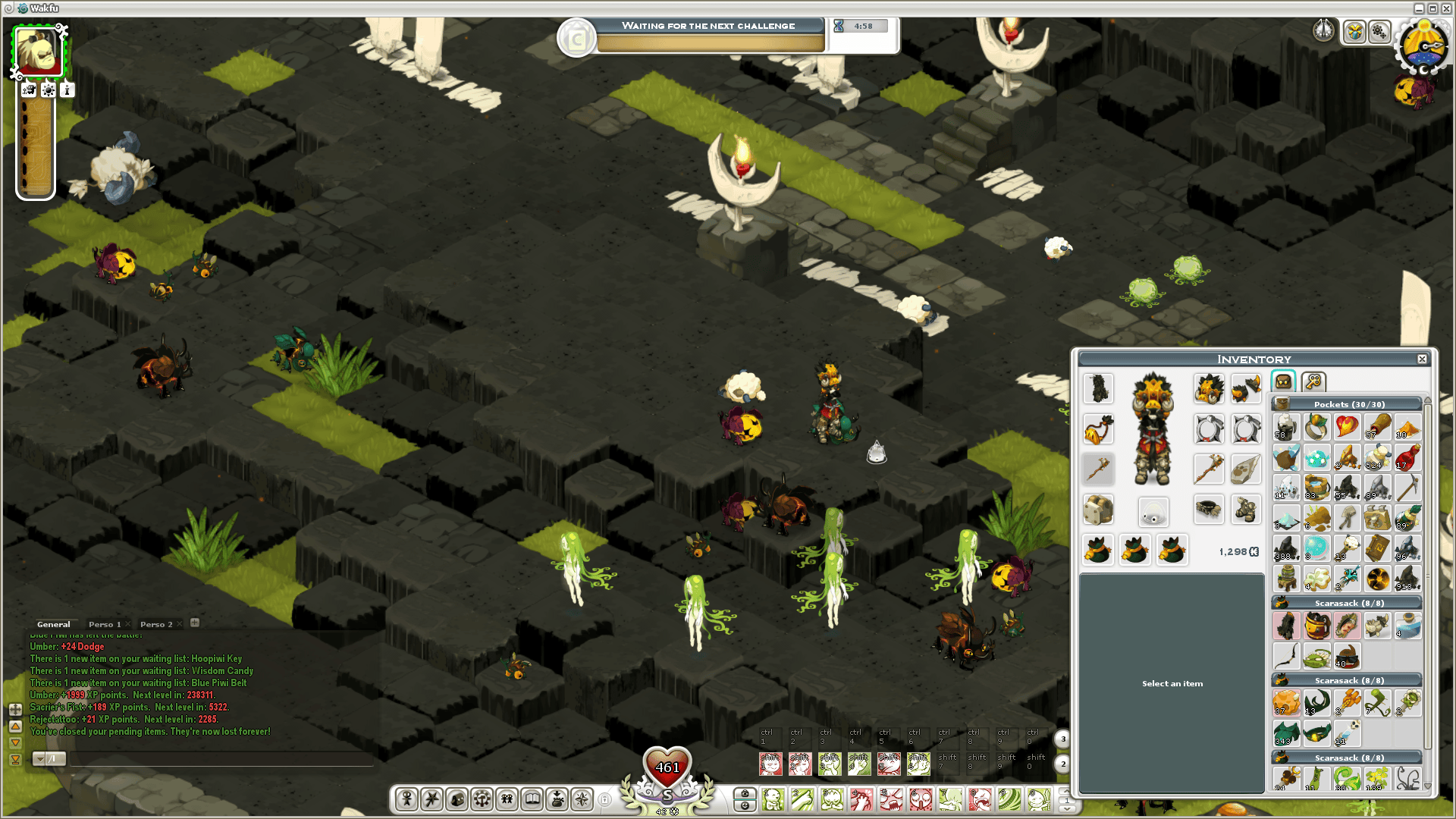 situations. Range and movement speed disparities between classes also can make for some imbalanced combat situations as well. Again, it seems as though Ankama Games is making an effort to level the playing field, though even this can cause frustration as the game mechanics that players are used to change.
The social aspect of an MMO is probably one of the greatest draws, and when it’s strong, players are willing to forgive some pretty major oversights and issues on the parts of the developers. Wakfu‘s chat interface is decent, but one massive oversight seemed to be the lack of any kind of help channel or global chat. When you create a new character, there is a very rudimentary tutorial section to play through, and then you’re thrown head-first into the game. In my experience, the tutorial section raised more questions than it answered, and there was really no avenue to get an explanation other than to look at the unreliable 3rd party wiki sites or try (largely unsuccessfully) to ask passing players. Aside from the absence of a global chat or help, the message window system is actually quite robust and offers players a wide range of customization options, from resizing and repositioning windows to the creation of multiple tabs and setting filters on each view.
While I was playing, the nation I belonged to declared war on another of the four nations. At first I was worried that this would result in the area being inundated with elite enemy gank squads, but no such thing happened. Mostly nothing happened at all, for which I was thankful, though rumours abounded about complex high-level guild maneuvering. Apparently there are high-level islands which can be conquered and which contain special resources. No one I talked to seemed to know a great deal about them, but everyone seemed quite sure they existed. (A situation which summed up so much of my experience in Wakfu.) Each nation has a certain kind of resource in abundance, so in theory alliances and warfare could interact powerfully with the game’s economic system. With so few players, however, there wasn’t much demand for anything, and the war didn’t have much of an effect. (But, you know, maybe someday!)
Wakfu is advertised as a Free to Play game, and offers quite a bit of content free of charge. The main drawback to free membership is the fact that you cannot make or own money, making it impossible to sell any loot you find. Players on free accounts will also be unable to enter dungeons outside the starting area, which is generally where the best items are found. Combined with the inability to have money, this mostly restricts players to begging for gear at higher levels, if they want the good stuff. Furthermore, only a few of the crafting professions can be trained.
Paying also has other benefits: depending on the duration paid for up-front, players receive different pets (and the bonuses they confer) and haven gem pieces. The Wakfu site also offers a variety of other in-game items and equipment which can be bought for real money, including special weapons which level up to confer significant bonuses. Depending on how the developers handle this aspect however, it could quickly turn into a pay to win system, which (at least in my experience) tends to have a strongly negative impact on a game.
While still in it’s early stages and somewhat unpolished, Wakfu offers something rare and precious in today’s MMORPG world: a game system that isn’t a duplicate of World of Warcraft. For laid-back casual fun, give Wakfu a try. (Why not? It’s free!)